
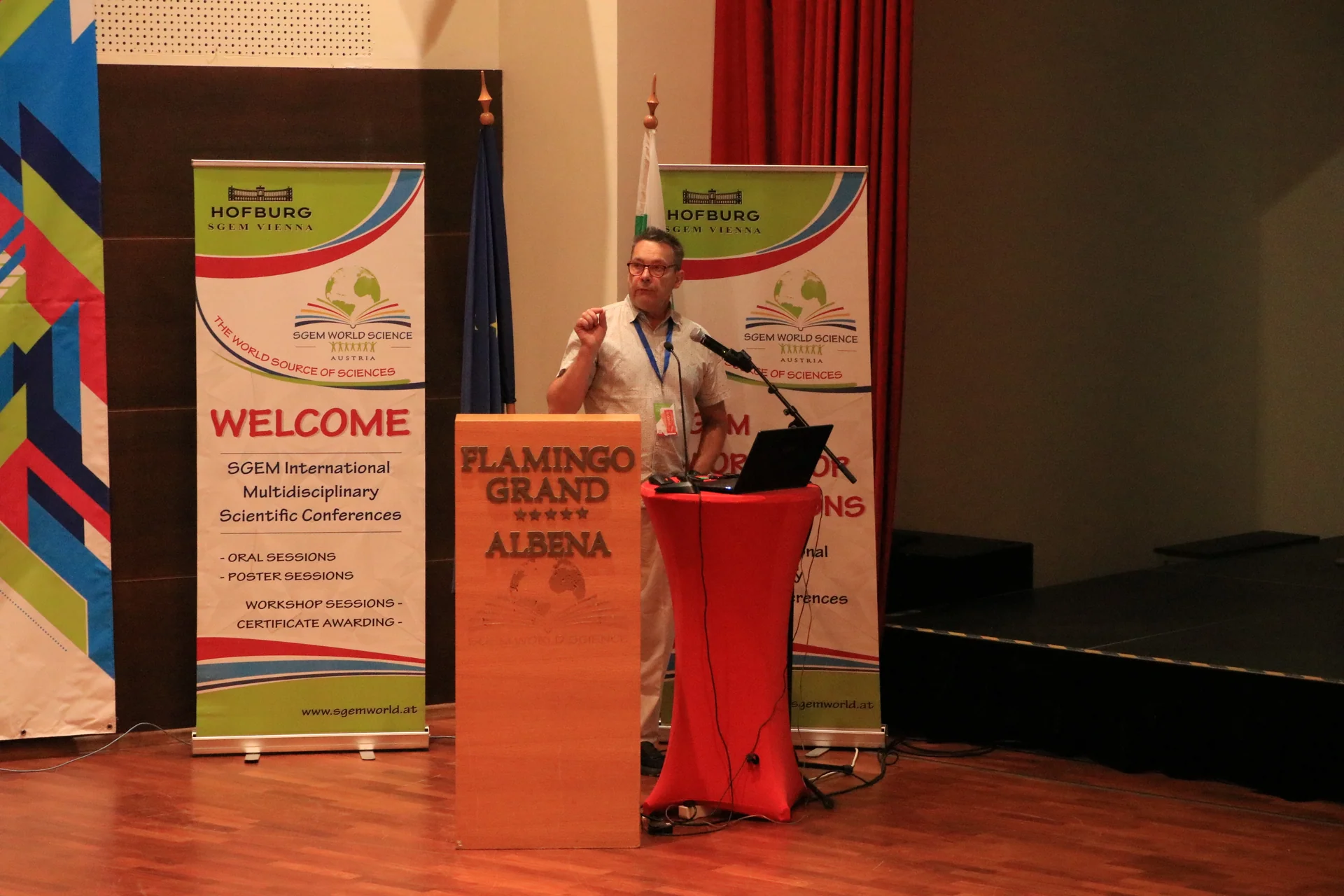
From 6 to 12 July 2026, the International Scientific GeoConference SGEM brought researchers together in the elegant setting of Flamingo Grand, Albena, on Bulgaria’s Black Sea coast. For one week, the GeoConference became a meeting point for scientists exploring the Earth, its resources and the technologies shaping our relationship with the planet.
Geoscience offers a particularly powerful setting for multidisciplinary exchange. Water moves through geological structures; soils connect landscapes, ecosystems and food production; energy and mineral resources link the subsurface with engineering, economics and environmental responsibility. Understanding these relationships calls for different kinds of expertise. At SGEM, geology and resource exploration met geoinformatics, remote sensing and artificial intelligence, while research on water, soil and biodiversity connected with clean energy, environmental protection and emerging technologies.
The 2026 scientific programme encompassed over 480 scientific papers across oral, poster and virtual formats, alongside three dedicated workshops. Together, they brought a wide range of research questions into a shared scientific setting — from the stability of the ground beneath our cities to the efficient use of resources and the exploration of environments beyond Earth.
That breadth came to life through people. Oral presentations prompted interesting questions and discussion; poster sessions created space for closer exchanges around methods and findings. Across sessions, workshops and informal encounters, participants could follow an unfamiliar approach, meet its researchers and recognise connections with their own work. The strength of the week lay in that movement between disciplines: new perspectives, constructive debate and opportunities to carry the conversation forward.
The story, day by day
Seven days. Many ways to see further.
Choose a day to follow the conference.
Day 01 · 6 July 2026
From the subsurface to the decisions above it
The opening day at Flamingo Grand moved straight into the questions facing contemporary geoscience. Michael Spevak presented AI-assisted structural interpretation for mining projects in the Caucasus and Balkans. Piotr Kardasz followed with physical and AI-based approaches to engine run-up modelling. The focus then shifted to the January 2026 geomagnetic storm, ground instability in a salt-karst urban area and the potential of enhanced geothermal systems in Poland.
The afternoon oral sessions brought these methods closer to practical decisions: predicting groundwater retention, locating landslide slip surfaces, assessing foundation changes and understanding seismic amplification. Interesting questions and discussion accompanied the presentations, making the exchange between speakers and audience an important part of the opening day.
Beyond the oral programme, the Welcome Drink created an informal setting for introductions and conversation. Research interests acquired faces and names; the week was beginning to become a community.
Day 02 · 7 July 2026
Reading rocks, recognising risk, looking beyond Earth
Tuesday’s oral programme began with Zbigniew Ziarek’s investigation of the Ciężkowice sandstones, using experimental flume modelling to explore their origin. The next contribution changed the scale dramatically: Jakub Zalewski and colleagues introduced the tracked #COSMOBOSS microrover for extraterrestrial surface exploration. Work on landslide risk then returned the discussion to the challenges of understanding and protecting terrestrial landscapes.
The poster session offered a closer encounter with individual studies. Gulnara Omarova presented mineralogical forms of finely dispersed gold, while Petr Kozlovcev explored the historical use of marble in traditional lime production. These were opportunities to pause over evidence, ask questions and discuss methods directly, alongside the broader exchange in the oral sessions.
A workshop led by Dragos Tataru, Eduard Nastase and Boni Mihai connected geoscience research with education and society. Instruments and experiments became ways to make hazards and Earth processes understandable beyond the laboratory — a practical counterpart to the day’s specialist presentations.
Day 03 · 8 July 2026
The landscapes we inhabit — and the worlds we imagine
Wednesday opened with the relationship between research and the places where people live. Ada Wolny-kucinska examined how urban registers can support more sustainable land use; Kaspars Krauklis addressed groundwater availability through a Latvian case study. Irina Pilvere’s contribution on crop rotation brought soil health, environmental sustainability and socio-economic effects into the same conversation.
Around the posters, Jozef Kubas’s work on GIS for crisis-management risk analysis and Roman Kumladze’s combined print and web atlas of Kvemo Kartli showed different ways of turning spatial information into usable knowledge. Questions and exchanges between participants gave room to explore the detail behind the maps and models.
The workshop “Holiday on the Moon — Prospect or Defiance?”, led by Ildiko Tulbure, opened another horizon. Life support, radiation, infrastructure and sustainability turned a distant possibility into a serious interdisciplinary problem. The contrast was memorable: a day devoted to managing our own landscapes also asked what it would mean to venture responsibly beyond them.
Day 04 · 9 July 2026
Measuring performance, understanding consequences
Thursday’s oral sessions put energy systems and resource use in focus. Rajendra Babu Roka compared the thermal performance of borehole heat exchangers across Europe. Peter Krizan explored mathematical control of solid biofuel production, and Ildiko Tulbure considered AI in the efficient use of renewable energy resources. Presentation followed presentation, connecting technical performance with the wider demands of sustainability.
The poster programme moved into the living landscape. Antonin Kintl’s study considered indicators of winter cover-crop decomposition; Jakub Pagac examined land abandonment and landscape succession. The change of format allowed the scientific conversation to continue through individual questions and discussions beside the research itself.
The workshop on salt karst and urban instability, led by Eduard Nastase and Dragos Tataru, brought monitoring methods together: geophysics, UAV LiDAR, GNSS, terrestrial scanning and satellite observations. It gave the day a clear point of convergence — the importance of connecting reliable measurements with decisions about risk and public safety.
Day 05 · 10 July 2026
Where environmental ambition meets real-world choices
Friday’s oral programme began with the economic and environmental dimensions of change. Baiba Rivza addressed automotive electrification in Latvia in the context of the European Green Deal. Olga Kudryavtseva examined municipal waste management and the circular economy, followed by Aija Pilvere’s assessment of the economic and environmental effects of feed additives in dairy farming.
These contributions placed different parts of the sustainability transition side by side: transport, waste and food production. Questions and discussion accompanied the presentations, giving participants space to compare approaches across sectors rather than follow each subject in isolation.
The posters widened the scientific range. Vitaly Erukhimovitch presented spectroscopic identification of bacterial plant pathogens, while Muza Kirjusina explored a luminescent dye for improved muscle imaging. Moving from the oral sessions to these focused exchanges revealed another strength of the meeting: the opportunity to encounter methods and ideas outside one’s immediate specialism, with the researchers there to discuss them.
Day 06 · 11 July 2026
Making research useful, tangible and shareable
Saturday connected analytical methods with the ways knowledge is applied and communicated. The oral programme moved from nutrient-cost optimisation and Krasimira Stoilova’s work on short-term business-expense forecasting to Kinga Stecula’s use of virtual reality in environmental learning. Alongside further contributions on digital terrain models and 3D printing, the day showed how scientific information can become something others can explore and use.
The poster session offered equally concrete examples. Georgiana Gabriela Codina examined the effects of wheat sourdough on dough properties, while Peter Futas presented thermal analysis for controlling ductile-iron melting. Materials, processes and measurements provided starting points for direct questions and discussion.
Across the oral and poster formats, the exchange kept returning to the practical life of research: its applications, its communication and its connections with other disciplines. The day carried the week forward through specific studies, while leaving room for participants to follow the questions most relevant to their own work.
Day 07 · 12 July 2026
One final morning, with the horizon still open
The final oral session retained the breadth of the week. Andrei-Dan Sabau presented laboratory equipment for assessing the hygrothermal performance of insulation materials. Aleksander Roratowski then explored alternative ways of investigating extraterrestrial surfaces, before Stoyo Todorov brought the focus to safety and environmental protection at railway crossings under repair.
The sequence carried the audience from the behaviour of building materials to planetary exploration and the infrastructure of everyday life. Questions and discussion remained part of this final scientific exchange. The morning’s oral programme led towards the certificate ceremony and the formal conclusion of the meeting.
The programme then turned towards Aladzha Monastery and Varna. After the concentrated work of the sessions, the cultural visit offered another setting in which to spend time together and continue conversations. The conference was drawing to a close, but the connections made during the week did not have to end with its last presentation.
Beyond the conference hall
A shared journey, on and off the programme
The off-site scientific session in Varna extended the conference beyond Albena. Around the scientific programme, shared experiences offered another way to get to know colleagues: the pre-conference journey through Demir Baba Tekke, Cape Kaliakra and Balchik, the opening Welcome Drink, and the closing excursion to Aladzha Monastery and Varna.
A change of setting gave conversations room to continue. The social programme brought people together beyond their presentation slots, adding the landscape and cultural heritage of the region to the experience of the week.
What made being there valuable
The conversation after the presentation
The value of the meeting lay as much in the exchange as in the presentations themselves: interesting questions after talks, discussions around posters, and informal conversations that brought different scientific perspectives together.
A researcher could listen to an unfamiliar method, ask its presenter a question and discover where it connected with their own work. That opportunity — to turn a paper into a conversation and a shared interest into a possible future collaboration — gave the week its lasting appeal.